

Why More Buildings Choose Telescopic Sliding Door Over Sliding Door ?
An increasing number of buildings are opting for automatic telescopic sliding doors instead of conventional sliding doors. The core reason is that telescopic sliding doors offer significant advantages in space utilization, traffic efficiency, and application scenario compatibility. Meanwhile, with their growing technical maturity and improved cost-effectiveness, they perfectly meet the design and functional requirements of modern buildings, especially commercial complexes, transportation hubs, and high-end office buildings. Below is a detailed comparative analysis.
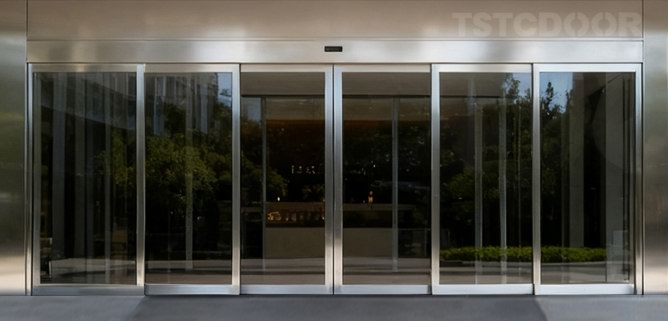
I. Core Advantage-Revolutionary Improvement in Space Utilization
This is the most core competitiveness of telescopic sliding doors and the key difference from conventional sliding doors.
To conventional sliding doors, the door leaves slide horizontally to both sides along the track when opening, requiring lateral space equal to the width of the door leaves. For example, a 1.2-meter-wide sliding door needs a clear space of at least 1.2 meters on each side; otherwise, it will conflict with walls, columns, display cabinets, and other obstacles.
To automatic telescopic sliding doors, adopt a multi-leaf nested and overlapping design. When opening, the door leaves fold and overlap to one or both sides along the track, only requiring lateral space equal to the width of a single door leaf. Taking a 4-leaf telescopic door as an example, the total passage width can reach 3 meters, while the lateral occupied space is only the width of a single door leaf (about 0.75 meters), achieving a space saving rate of over 50%.
This advantage is crucial for space-constrained buildings (such as shopping mall entrances, office building elevator lobbies, hospital corridors, and high-speed rail station ticket gates). It not only ensures a wide passage but also frees up lateral space for commercial displays, facility placement, or pedestrian flow management.
II. Higher Traffic Efficiency, Suitable for High-Flow Scenarios
Wider passage width. Telescopic sliding doors can easily achieve ultra-wide passageways (up to more than 6 meters maximum). Moreover, the door leaves are completely overlapped on one side when opened, with no obstruction at all, suitable for simultaneous passage of multiple people or the entry and exit of large equipment, trolleys, and wheelchairs.
Adjustable opening and closing speed. The opening and closing speed of high-end telescopic door systems can be intelligently adjusted according to pedestrian flow,fast opening and closing during peak hours to improve traffic efficiency, and low-speed operation during off-peak hours to reduce energy consumption and noise.To the conventional sliding doors, restricted by lateral space, the passage width is usually small (generally no more than 2 meters).
III. Wider Application Scenarios and Stronger Compatibility
Special building spaces.For special designs such as curved walls, corner entrances, and narrow passages, the nested structure of telescopic sliding doors can flexibly adapt to track layouts, while conventional sliding doors cannot be installed due to lateral space limitations.
High-end building requirements.The multi-leaf linkage design of telescopic sliding doors is more technologically advanced and aesthetically pleasing. It can be matched with materials such as glass and metal, and highly fits the minimalist style of modern buildings. It is often used in the entrances of high-end office buildings, five-star hotels, and luxury stores.
Industrial and public buildings. In scenarios such as factories, warehouses, and garages, telescopic sliding doors can achieve large-span opening, and at the same time have good sealing and wind resistance, while conventional sliding doors are difficult to meet large-span requirements.
To sum up, the rise of automatic telescopic sliding doors is essentially the upgrade of modern buildings' demand for space efficiency and functional experience. In core fields such as commerce, transportation, and high-end office, the space advantage, traffic efficiency, and aesthetics of telescopic sliding doors make them a better choice. With the popularization of technology and the reduction of costs, their application scenarios will be further expanded. Conventional sliding doors will continue to play a role in niche and low-cost scenarios, forming a complementary rather than alternative market pattern .
 Certificate of Origin (CO) For
 The Research For Global Hermet
 Are Revolving Doors Worth Inst
 Liabilities For Seller & B