

Application of Image Recognition Technology in Automatic Doors
For a long time, automatic doors have mainly relied on infrared sensors and microwave radar sensors to detect approaching pedestrians and trigger opening actions. Although these traditional sensing methods are widely used, they have obvious limitations: they are prone to false triggering caused by moving objects such as pets, falling leaves and passing shadows, and they cannot judge pedestrian movement trajectories or distinguish people from other obstacles. With the rapid development of computer vision and artificial intelligence algorithms, image recognition technology has gradually been applied to sliding automatic doors, swing doors and automatic revolving doors, bringing revolutionary upgrades to sensing triggering, safety protection, access management and operation data statistics of automatic door systems.
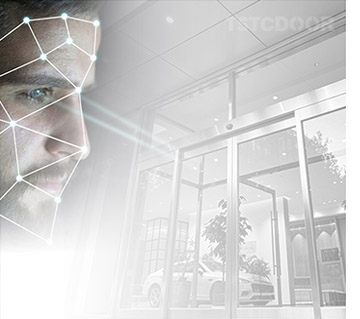
The core value of image recognition technology lies in its ability to capture real-time images through high-definition cameras and use trained AI models to classify, identify and track targets in the field of view. Different from traditional sensors that only detect the existence of heat or moving objects, visual sensors can accurately recognize human shapes, filter interference sources, and judge the moving direction and intention of pedestrians. When a pedestrian walks towards the door, the system identifies the human target in advance and sends an opening signal to the door operator, when only animals or debris enter the detection area, the system will ignore the signal and avoid unnecessary door opening. This greatly reduces false activation, helps reduce the frequency of door operation, and indirectly improves the energy-saving performance of automatic revolving doors and other entrance products.
Safety protection is another key application scenario of image recognition in automatic doors. The visual system can realize intelligent anti‑clamping and anti‑collision monitoring. It continuously monitors the door leaf movement area in real time. If pedestrians, children or luggage stay or fall within the door closing path, the image recognition module will immediately send a stop or reverse signal to the drive motor before physical contact occurs, forming a secondary safety barrier together with infrared safety strips and mechanical buffers. For automatic revolving doors with high safety requirements, visual recognition can also detect the risk of passengers being trapped in the door compartment, identify abnormal crowd congestion, and trigger alarm or slow‑down instructions in time, effectively lowering safety accidents in high‑traffic places such as hotels, airports and commercial complexes.
Image recognition also expands the access control capability of automatic doors. Combined with facial recognition algorithms, the automatic door can realize authorized access control. The camera collects facial features of visitors, compares them with the preset white list database, and only opens the door for verified personnel. This solution is suitable for office buildings, laboratories and restricted areas that require identity authentication. Meanwhile, the visual module supports passenger flow statistics: it automatically counts the number of people entering and exiting, records peak passenger periods, and feeds back data to the door control system. The automatic door can adjust rotation speed or door‑holding time dynamically according to real‑time passenger flow, balancing passing efficiency and equipment loss.
Nevertheless, image recognition automatic door systems still have restrictive factors in practical application. Recognition accuracy will be affected by strong backlight, heavy fog and dim lighting environments, so most products are equipped with infrared night vision supplements to maintain stable recognition around the clock. In addition, privacy protection needs to be fully considered during design. Many manufacturers adopt local image processing schemes instead of uploading original pictures to the cloud, and only retain feature data for comparison, which complies with data security and privacy regulations. It is also common to adopt a hybrid sensing scheme: image recognition works together with microwave and infrared sensors to complement each other’s strengths and ensure stable operation under complex weather and light conditions.
As intelligent building entrances continue to evolve, image recognition is becoming an important configuration for high‑end automatic door products. It transforms automatic doors from simple “inductive switches” into intelligent entrance terminals with perception, judgment and data analysis capabilities. For manufacturers, integrating visual recognition helps improve product differentiation and safety performance, for property managers and architects, it reduces false triggering failures, cuts maintenance costs and optimizes the experience of building entrances. In the future, with the continuous optimization of lightweight vision algorithms and embedded hardware, image recognition technology will be more widely popularized in automatic revolving doors, medical automatic doors and various smart entrance systems.
Note: As one of China’s leading automatic door suppliers, TSTC has specialized in the automatic door industry for more than 10 years. Our core management, technical and sales personnel each boast over 15 years of experience in this field. Our main products include ordinary 3/4 wing revolving door TAR300, 2 wing luxury revolving door TAR200, all-glass revolving door TAR600, the best popular hospital hermetic door TH100, and the best selling swing door operator TSW100. Our automatic doors above have already been exported to over 20 countries across Southeast Asia, Europe,the Americas, trusted by numerous prestigious Hotels, Hospitals, Office Buildings, Chain Supermarkets and Commercial Complexes.
 Application of Image Recogniti
 Lead-Lined Door / Radiation Pr
 Commercial Automatic Doors on
 Holiday Notice For China Natio