

How To Achieve The Airtightness of Medical Hermetic Doors?
The airtightness of medical airtight doors (such as the doors in hospital CT rooms, operating rooms, ICUs) is achieved primarily through the sealability of structural design combined with the cooperation of special sealing components, as well as the door's driving and compression mechanisms. When the door is closed, a closed airtight space is formed to prevent air convection, dust or pathogen transmission. Its realization involves three core modules door body structure, sealing components, and driving & compression system, detailed as follows .
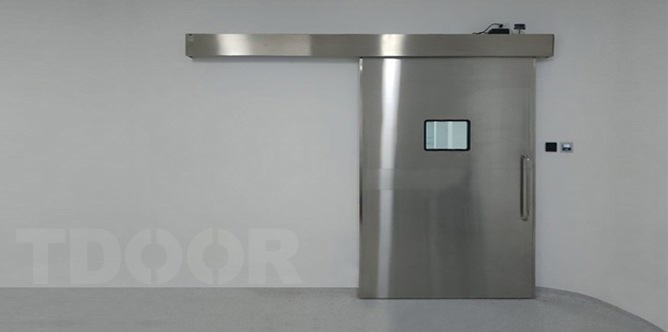
I. Core Sealing Structure Design
1. Matching Structure of Door Body and Door Frame
▪ Step-type/zigzag interlocking structure. The door body and door frame adopt a concave-convex interlocking step-type design instead of flat direct splicing. When closed, it forms multiple physical barriers to reduce the path of air infiltration through gaps. For example, a flange is set on the inner side of the door frame, and a corresponding groove is set on the edge of the door body, forming the first sealing barrier after interlocking.
▪ Integrally welded and sealed door body. The door panel is made of stainless steel or radiation-proof lead plate and other materials through integral welding technology to avoid splicing gaps, the interior of the door body is filled with sealing and thermal insulation materials such as polyurethane foam, which not only enhances the air tightness of the door body but also improves sound insulation and thermal insulation effects.
▪ Sinking/sliding door track design. Most automatic sliding airtight doors adopt a sinking track. When the door is closed, it sinks slightly to make the bottom of the door body fit closely with the ground, sliding doors achieve seamless docking between the door body and the side of the door frame through the precise guidance of the track.
2. Sealing Groove Design Around the Door Opening
Sealing grooves are preset around the door frame, and sealing parts are embedded in the grooves. The depth and width of the sealing grooves match the sealing parts to ensure that the sealing parts can fully deform after being compressed by the door body and fill the gaps. Meanwhile, the sealing grooves adopt a waterproof and dust-proof structural design to avoid debris affecting the sealing effect.
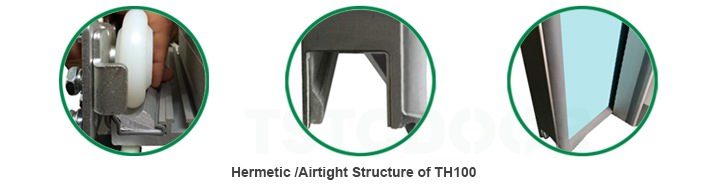
II. Key Sealing Components
Sealing components are the core consumables for achieving air tightness, which need to have the characteristics of wear resistance, aging resistance and good elasticity. The common types and application positions are as follows.
1. Rubber Sealing Strips
▪ Materials. Silicone rubber (resistant to high and low temperatures, anti-aging) or ethylene propylene diene monomer (EPDM, strong weather resistance) is mostly used. The sealing strips of some radiation-proof doors are mixed with lead powder to enhance the radiation-proof effect.
▪ Application positions
Edges around the door body. Annular sealing strips are pasted or embedded, which closely contact the door frame when closed to form a circumferential seal.
Bottom of the door body. An automatic lifting sealing strip (equipped with a cylinder or spring mechanism) is installed. When the door is closed, the sealing strip sinks to fit the ground to prevent air leakage from the bottom.
Middle seam of double airtight doors. A mother-son type sealing strip is set for interlocking sealing.
2. Inflatable Sealing Strips (High-end Airtight Doors)
▪ Principle. After the door is closed, compressed air is filled into the strip to make it expand and fit closely to the door frame and door body, forming a high-pressure seal with much higher air tightness than ordinary rubber strips, before the door is opened, the strip is deflated and shrunk to avoid wear.
▪ Application scenarios. Areas with extremely high air tightness requirements such as operating rooms and sterile wards.
3. Glass Window Sealing Components
Between the observation window (mostly double-layer tempered glass) on the door body and the door frame, a double seal of a sealing rubber ring and sealant is adopted to prevent air leakage at the edge of the observation window.
III. Driving and Compression System (Automatic Airtight Doors)
Automatic medical airtight doors need a mechanical compression mechanism to ensure that the door body is in full contact with the sealing parts and avoid gaps. The core components arer as below.
▪ Sliding door drive motor and synchronous belt. Precisely control the moving speed and closing position of the door body to ensure the door body is aligned with the door frame and avoid seal failure due to misalignment.
▪ Compression cylinder/electromagnetic attraction device.
Cylinder compression. After the door is closed, the cylinder pushes the door body to press against the door frame, making the sealing strip fully deform and enhancing the sealing performance.
Electromagnetic attraction. An electromagnetic magnet is embedded in the door frame. After the door is closed, it is energized to attract the door body firmly to the door frame and compress the sealing strip.
▪ Sensor and control system. Equipped with infrared sensors and pressure sensors to detect the closing state of the door body in real time. If the sealing is not up to standard, the system will issue an alarm or re-drive the door body to compress.
▪ Door body balance device. The weight of the door body is balanced by springs or counterweights to avoid sealing gaps caused by the gravity shift of the door body.
IV. Auxiliary Airtight Measures
▪ Wall sealing around the door opening. The connection between the door frame and the wall is filled with cement mortar and sealed with sealant to prevent air leakage at the connection part between the wall and the door frame.
▪ Linkage with air pressure adjustment system. Areas where airtight doors are located (such as operating rooms) are usually equipped with positive/negative pressure fresh air systems, which reduce air infiltration through air pressure difference and form a double airtight guarantee with the airtight doors.
▪ Regular maintenance components. Such as cleaning grooves and lubrication holes for sealing strips, which facilitate regular cleaning and maintenance and avoid the aging of sealing strips or dust accumulation affecting the sealing effect.
 Certificate of Origin (CO) For
 The Research For Global Hermet
 Are Revolving Doors Worth Inst
 Liabilities For Seller & B